GOSHAWK
SATELLITE-BASED WATER LEAK DETECTION FOR CLIMATE RESILIENCE
Introduction
GOSHAWK develops a satellite-based system to detect hidden water leaks across urban networks, where up to 30% of water can be lost as Non-Revenue Water. By combining multi-frequency SAR data with optical Earth Observation and physics-informed artificial intelligence, it enables continuous, city-scale leak detection without the need to install any sensors, helping water utilities reduce these losses and strengthen climate resilience.
Objectives
- Mature a satellite-based urban leak detection system from the conceptual stage to an operational demonstration (from TRL 3 to TRL 6) in real municipalities.
- Fuse multi-frequency SAR data (Sentinel-1 in C-band and NISAR/ALOS-4/SAOCOM in L-band) with Sentinel-2 optical data and meteorological data into automated, analysis-ready data cubes.
- Develop a physics-informed artificial intelligence engine that respects radar physics to reduce false positives below the state of the art, targeting over 85% precision within a 60-metre radius against ground-truth reference data obtained through acoustic methods.
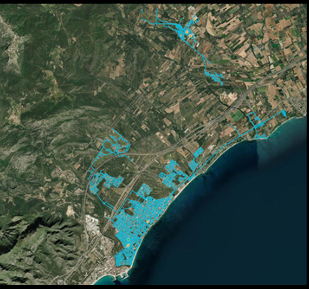
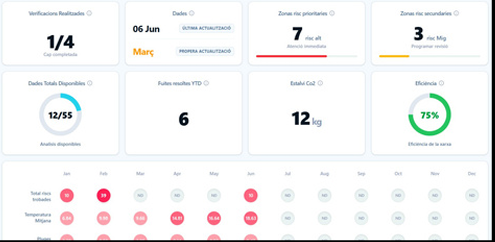
GOSHAWK leverages multi-frequency Synthetic Aperture Radar (SAR), which observes entire cities every few days regardless of weather conditions or daylight and detects subsurface soil moisture caused by leaks. Unlike opaque “black-box” services that are prone to false positives, GOSHAWK applies transparent physics-informed machine learning that respects SAR physics, using InSAR closure-phase filtering to reduce urban noise and enable street-level leak localisation with accuracy below 60 m, drawing on CTTC’s expertise in SAR and InSAR.
Impact on Climate Resilience
GOSHAWK contributes directly to climate resilience by reducing water losses in distribution networks, where up to 30% is lost as Non-Revenue Water. Every cubic metre of water saved avoids the energy, chemicals, and CO₂ emissions required to treat and pump it, reducing pressure on drought-stressed reservoirs.
The scale of the problem is significant. In Spain alone, between 800 and 1,000 hm³ are lost each year; a 40% reduction could recover up to 320–400 hm³ annually, equivalent to approximately 160–200 GWh of energy savings and €16–20 million in operating cost savings. By prioritizing hidden leaks before they reach the surface, GOSHAWK also helps reduce the digital divide for smaller municipalities, which are precisely those that most need to strengthen their climate resilience.
From Lab to Market: Customers and Commercial Roadmap
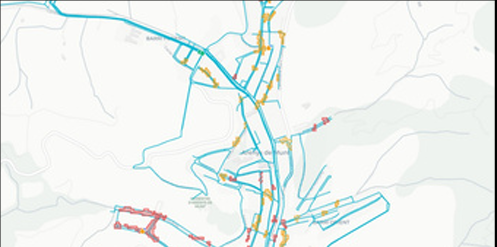
GOSHAWK targets the operators who need it most: small and medium-sized municipal water utilities, regional water agencies, and engineering firms that have historically been excluded from advanced leak analysis solutions due to their cost. It is developed and validated with GUSAM (Arenys de Munt) as a real operational “Living Lab,” connecting Earth Observation research with practical urban water management.
It operates as an accessible “Virtual Audit,” identifying areas with a high probability of leaks without the need to install hardware, and serves as an initial layer that enables water utilities to digitalise progressively. Demand is reinforced by the EU Drinking Water Directive (2020/2184). The roadmap foresees growth through provincial partnerships, starting with the Barcelona Provincial Council, and expansion across Spain toward European markets.
Consortium