ESA Phi-Lab Spain and ESA Phi-Lab Netherlands activate cross-border collaboration
Following a technical deployment at the Montsec Observatory (OdM) in Catalonia, this joint initiative demonstrates how the ESA Phi-LabNET framework facilitates cross-border innovation and infrastructure sharing.
Barcelona, 27 July 2026
What is the ESA Phi-LabNET?
The ESA Phi-LabNET is a Europe-wide initiative that brings together specialised innovation centres, each focused on specific thematic areas within the field of space technology. This network forms part of ESA’s ScaleUp Programme, which is designed to stimulate commercial activity by advancing technologies with strong market potential.
Rather than operating in isolation, each national Phi-Lab acts as a gateway to its country’s specific expertise, research capabilities, and infrastructure. By linking these hubs together, the network creates a unique framework where members can easily collaborate, share resources, and scale up commercial space projects.
Two nodes, complementary strengths
The recent collaboration between the Spanish and Dutch nodes perfectly illustrates the practical value of this network structure:
- ESA Phi-Lab Netherlands, based on NL Space Campus, focuses primarily on driving commercial innovation in fields such as Earth Observation (EO), critical PNT (Positioning, Navigation, and Timing) infrastructure, and secure satellite communications.
- ESA Phi-Lab Spain, coordinated by the Institute of Space Studies of Catalonia (IEEC), drives innovation in the space sector by supporting disruptive projects and fostering the transfer of space technologies to address climate resilience and accelerate their market application.
Through the ESA Phi-LabNET framework, a specific technical need from the Dutch team found its ideal operational solution within the Catalan infrastructure.
From Helsinki to the Montsec mountains
What started as a casual technical discussion at the European Planetary Science Conference in Helsinki back in 2025 has now turned into an active, operational activity on the ground.
During the conference, the team from ESA Phi-Lab Netherlands identified a clear synergy between their Dunedain Transients project, which explores novel optical methods to detect and track artificial satellites and orbital debris, and the satellite monitoring expertise of the researchers from the Montsec Observatory in Catalonia, managed by the IEEC.
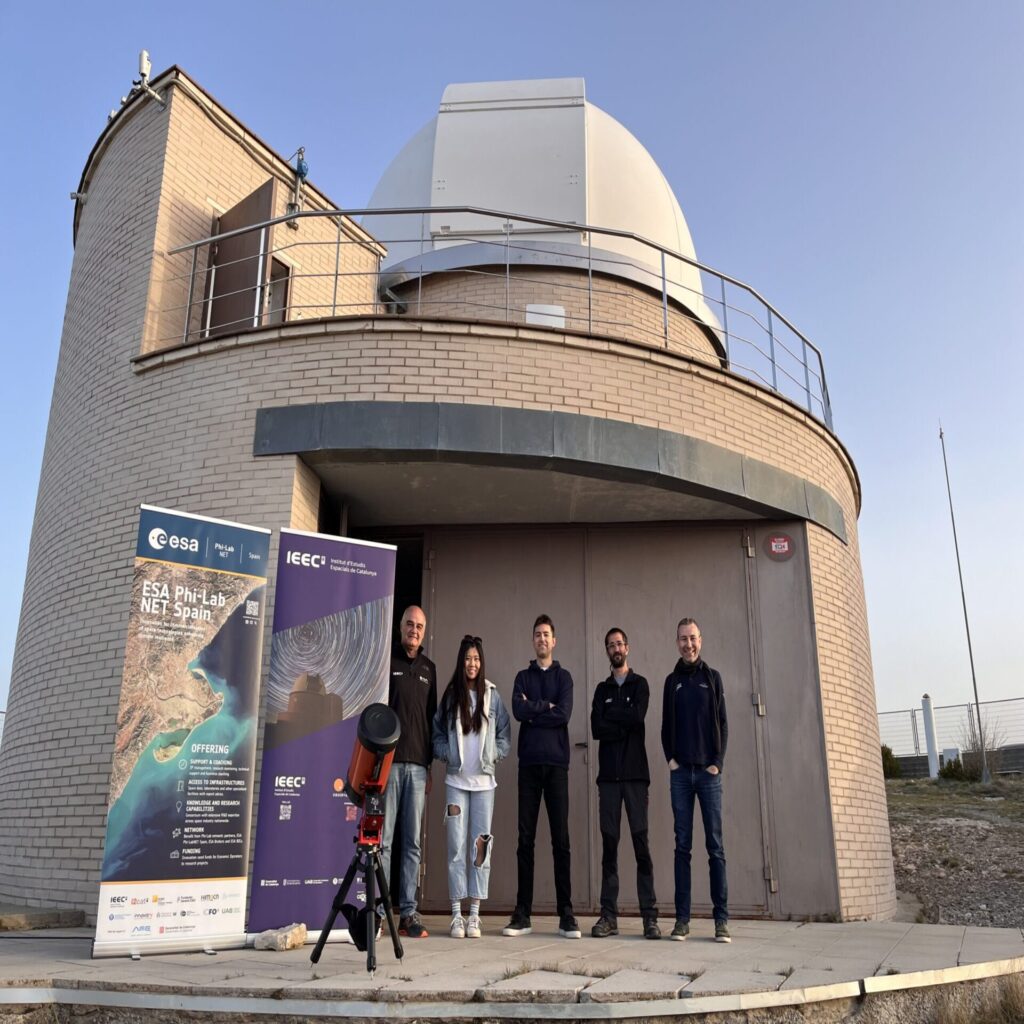
A few months ago, the Dutch team travelled to Barcelona to visit the ESA Phi-Lab Spain facilities at the IEEC headquarters.
However, the ultimate destination of their itinerary was the Montsec Observatory (OdM), a scientific and technological infrastructure located at an altitude of 1,570 meters, which provides the ideal dark skies and stable conditions required for high-accuracy space observation.
Moving beyond partnerships into shared infrastructure
Over the course of a day and a half of intense teamwork on-site, the joint team successfully installed and integrated the new Dutch instrumentation. Today, the equipment is fully up, running, and actively collecting data from the Montsec mountains.
Ultimately, this collaboration went far beyond sharing physical space at an observatory, it successfully combined the specific research goals of the Dutch team with the local infrastructure and technical expertise in satellite monitoring provided by the IEEC and ESA Phi-Lab Spain.
About ESA Phi-Lab Spain
ESA Phi-Lab Spain is a programme of the European Space Agency (ESA), supported by the Spanish Space Agency (AEE) and the Generalitat de Catalunya. The programme is part of ESA’s ScaleUp Programme, with a focus on promoting innovation and the commercialisation of space technologies to enhance climate resilience.
The programme is coordinated by the Institut d’Estudis Espacials de Catalunya (IEEC), which leads a consortium of twelve universities, research and innovation centres, and companies. These include the i2CAT Foundation, the Cartographic and Geological Institute of Catalonia (ICGC), the Fundación General CSIC, the KIMbcn Foundation, Arribes Enlightenment, the University of Valencia (UVEG), the Polytechnic University of Catalonia (UPC), the Barcelona Supercomputing Center (BSC-CNS), the Ricardo Valle Institute of Innovation Foundation (INNOVA IRV), the ESA MELiSSA Pilot Plant of the Universitat Autònoma de Barcelona (UAB), and the Institute of Photonic Sciences (ICFO)